

Why Summer Is Actually the Worst Season for Sleep (And What to Do About It)
Published on: August 4, 2026
By Marina Tonial, MPH, CHES®, Community Health Educator
We tend to think of winter as the hard season — dark afternoons, cabin fever, the January slump. But when it comes to sleep, summer may be quietly the most disruptive time of year. Longer daylight, warmer nights, more social obligations, and the busiest stretch of Cape Cod’s calendar all combine to erode the one thing your body needs most to keep up: consistent, restorative sleep.
And this isn’t just a matter of feeling groggy. Sleep is a core determinant of health, and the research on summer sleep disruption has gotten notably stronger in the past two years.
Your Body Needs to Cool Down to Fall Asleep
Falling asleep isn’t just a matter of turning off the lights. Your core body temperature naturally drops in the hour or so before sleep onset, and that drop is part of what signals your brain to transition into sleep. Warm extremities help you shed heat; a cool room helps the process along.
When the air around you stays warm, that cooling process stalls. Research has consistently found that heat exposure lengthens the time it takes to fall asleep, increases nighttime awakenings, and — most importantly — compresses the amount of time spent in slow-wave (deep) sleep and REM sleep, the two stages that do the most restorative work (Nature Index — Thermoregulation and Sleep Quality).
Most sleep researchers point to a bedroom temperature in the low-to-mid 60s°F as ideal for sleep. On a humid Cape Cod night in August, that’s often not what’s happening in an upstairs bedroom.
Warm Nights Are Getting Warmer
Here’s the part that turns this from a comfort issue into a public health one: overnight low temperatures are rising, and they’re rising in ways that measurably cut into how much people sleep.
A 2025 study out of the Keck School of Medicine at USC, published in Environment International, analyzed heat exposure and sleep across the U.S. and found that higher nighttime temperatures were linked to both shorter sleep and lower sleep quality — with the strongest effects among people with chronic health conditions and people with fewer economic resources. The researchers projected that by the end of the century, Americans could lose up to 24 hours of sleep per year to heat alone (USC / Environment International, 2025).
A Climate Central analysis released this summer put a number on the present-day cost: across 253 U.S. cities, people lost an average of roughly 36 hours of sleep per year to hot nights between 2020 and 2025, with about 13% of that loss attributable to human-caused warming (Climate Central, via FOX, July 2026).
The EPA and CDC have both flagged warm overnight temperatures as one of the more serious — and most overlooked — features of a heat wave. When nights don’t cool off, the body never gets its recovery window, and the physiological strain accumulates across consecutive days (ABC News / CDC & EPA, 2025).
The Other Summer Sleep Thieves
Heat gets the headline, but it’s not working alone:
- Extended daylight. Light is the primary signal setting your circadian rhythm. Sunset after 8 p.m. pushes melatonin release later, which pushes bedtime later — but work and camp drop-off times don’t move. The result is accumulated sleep debt across the season.
- Schedule creep. Cookouts, beach evenings, houseguests, concerts. Summer social life runs late, and Cape Cod’s summer runs later than most.
- Seasonal work. Many Cape residents work extended or split hospitality and service shifts in July and August, sometimes finishing well after midnight — and then trying to sleep through a bright, warm morning.
- Alcohol. It’s the season for it, but alcohol suppresses REM sleep and fragments the second half of the night, even when it helps you fall asleep faster.
What Actually Helps
Some of this is structural and outside any one person’s control. But a fair amount is manageable:
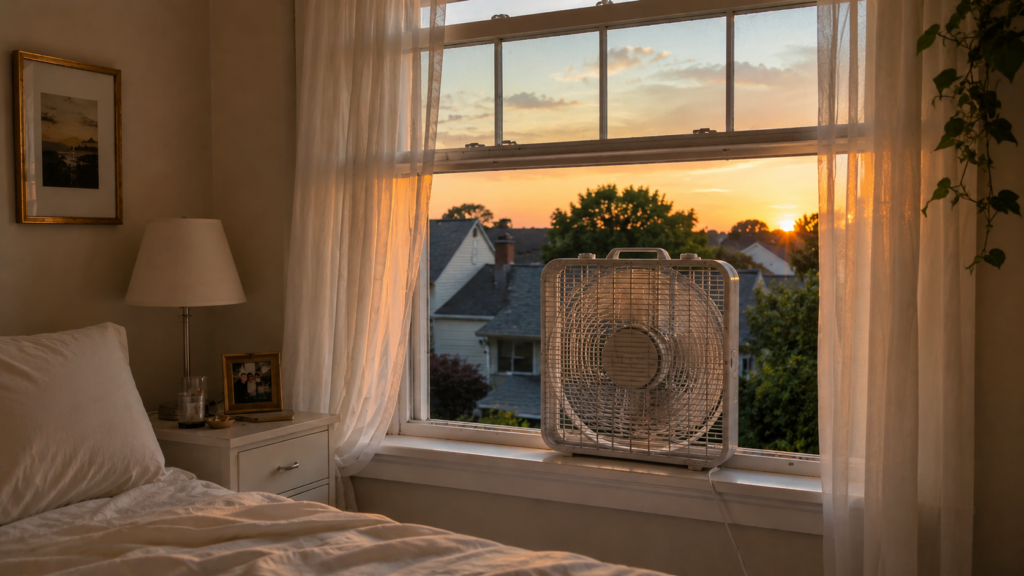
Cool the room, not the house. Cooling one bedroom is far cheaper and more effective than cooling a whole home. A window unit, a well-placed fan, or even a fan pointed out the window to exhaust hot air can make a meaningful difference. If you don’t have AC, run fans and close blinds during the day to keep heat from building up.
Take a warm shower before bed. It sounds backwards, but a warm shower an hour or two before bed brings blood to the skin’s surface and speeds up the drop in core temperature afterward.
Get morning light — it’s your strongest lever. Light exposure is the primary signal your brain uses to set its internal clock, and morning sunlight is far more powerful than indoor light. Getting outside early in the day does more to stabilize your rhythm through a long summer than almost anything you do at bedtime.
Dim the evening. Your brain only releases melatonin, the hormone that signals the start of the night, when the environment is dim. Bright light in the evening — screens included — suppresses it and pushes sleep onset later. Lower the lights in the two hours before bed, and use night-shift settings if you’re on a device.
Protect the wake time more than the bedtime. If a summer evening runs late, a consistent wake time does more to keep your rhythm stable than trying to sleep in and recover.
Skip the late-evening alcohol and heavy meals. Both interfere with thermoregulation and sleep architecture.
Hydrate during the day, not right before bed. Dehydration worsens heat strain, but front-load your fluids so you’re not waking up at 3 a.m.
Who Should Pay Closer Attention
Heat-related sleep disruption isn’t distributed evenly. Older adults, young children, people with cardiovascular or respiratory conditions, people who are pregnant, and people without access to air conditioning all face higher risk. If you have a neighbor or family member in one of these groups, checking on them during a stretch of hot nights — not just hot days — is genuinely worth doing.
Barnstable County residents can find information on cooling centers and heat safety resources through their local health department.
The Bottom Line
Sleep is not a luxury item you can defer until September. It’s a foundational health behavior tied to cardiovascular health, immune function, mental health, and cognitive performance. Summer makes it harder — and warming nights are making it harder still. A few adjustments to your sleep environment and evening routine can recover a meaningful amount of what the season takes.
Sources
- Nature Research Intelligence. Thermoregulation and Sleep Quality. https://www.nature.com/nature-index/topics/l4/thermoregulation-and-sleep-quality
- Liao, J., et al. (2025). Impact of heat exposure on sleep health and its population vulnerability in the United States. Environment International. https://www.sciencedirect.com/science/article/pii/S0160412025006932
- Keck School of Medicine of USC (December 2025). Rising nighttime heat is linked to shorter and more disrupted sleep. https://www.news-medical.net/news/20251204/Rising-nighttime-heat-is-linked-to-shorter-and-more-disrupted-sleep.aspx
- Climate Central (July 2026). Analysis of nighttime temperatures and sleep loss across 1,338 cities. https://www.fox5dc.com/news/hotter-nights-costing-you-sleep-heres-how-much
- ABC News (July 2025). Summer nights are getting warmer due to climate change, sparking health concerns (citing CDC and EPA guidance). https://abcnews.com/US/summer-nights-warmer-due-climate-change-sparking-health/story?id=124140866
- Obradovich, N., et al. (2017). Nighttime temperature and human sleep loss in a changing climate. Science Advances. https://www.science.org/doi/full/10.1126/sciadv.1601555
Legal Disclaimer:
EIN Presswire provides this news content "as is" without warranty of any kind. We do not accept any responsibility or liability for the accuracy, content, images, videos, licenses, completeness, legality, or reliability of the information contained in this article. If you have any complaints or copyright issues related to this article, kindly contact the author above.
